
Classic Games Database
ClassicGames DB

Ruins of Cawdor

Review

This 1995 graphical MUD RPG tasks you with exploring six castle floors, battling monsters and solving puzzles, best tackled with a party.

Ruins of Cawdor was developed by Ybarra Productions and published by Sierra On-Line for DOS in 1995; no earlier platform version exists.


							Ruins of Cawdor cover
Play Game Play directly in your browser
Platform
MS-DOS
Released
1995
Perspective
1st-person
Size
1.62 MB
Version
autorun.bat
Rating
0 votes

About Ruins of Cawdor

Ruins of Cawdor is the third title in a multi-user dungeon series from The Sierra Network. Its narrative foundation is drawn from Macbeth, providing a distinct story while utilizing the same technical framework as its predecessors, The Shadow of Yserbius and Fates of Twinion.

Character creation involves selecting from several guilds, including wizard, thief, knight, cleric, barbarian, and ranger. The primary activity consists of navigating the six floors of Castle Cawdor, where players engage in combat, locate magical objects, and uncover hidden passages. Progress is tied to solving various puzzles encountered during exploration.

Ruins of Cawdor Screenshots

10 images
Naming a new character and making a few important decisions
The attributes screen, indicating some of the underlying mechanics
The character's appearance modification screen can be quite important, as the result will be the player's avatar seen by others players from the ImagiNation Network.
A few example tweaks of the character appearance
The game does not offer a playable in-game tutorial, however a 'Getting Started' screen is available.
The first screen after picking a character, with four clickable elements.
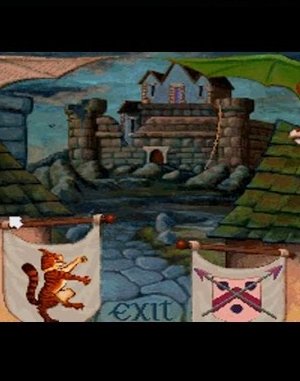
The Inn, serving as a global notice board and a lobby for players to interact and join each other for adventures.
The player is shown a large amount of flavor text when exploring, with many humorous passages...
...including some light-hearted innuendos.
The game's combat system, with enemy graphics being either generated portraits similar to the character's for humanoids, or hand-drawn (and animated) graphics for monsters.