
About Super Mario Bros.
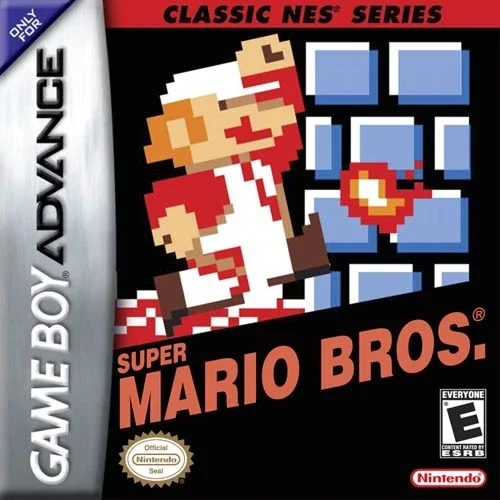
Classic NES Series: Super Mario Bros. brings Nintendo's original Super Mario Bros. to the Game Boy Advance with very few changes to the game itself. Released in 2004, this is not a remake with new graphics or redesigned levels. It is essentially the classic NES game running on Nintendo's 32-bit handheld.
That makes it quite different from Super Mario Bros. Deluxe, the expanded Game Boy Color version released several years earlier. Deluxe added extra modes and other changes, while the Classic NES Series release was made for players who wanted something much closer to the original 8-bit experience.
The Original Super Mario Bros. on GBA
The adventure is the same one that helped define the NES. Bowser has taken over the Mushroom Kingdom and kidnapped Princess Peach, leaving Mario and Luigi to travel through eight worlds to reach his castle.
There are 32 main stages spread across those eight worlds. Mario runs from left to right, jumping over pits, breaking blocks, entering pipes and dealing with familiar enemies such as Goombas, Koopa Troopas, Piranha Plants and Bullet Bills.
The controls are simple, but there is more going on than just running and jumping. Mario's momentum affects how far he travels through the air, and learning when to run at full speed is important for longer jumps. Many stages also hide coins, power-ups and shortcuts inside blocks or pipes.
Power-Ups and Classic Mario Gameplay
Mario begins each life in his small form. Collecting a Super Mushroom turns him into Super Mario, allowing him to survive an extra hit and break certain brick blocks from below.
A Fire Flower gives Mario the ability to throw bouncing fireballs, which can defeat many enemies without jumping on them. The Starman temporarily makes Mario invincible, while 1-Up Mushrooms provide an extra life.
Coins are scattered throughout the levels, and collecting 100 earns another life. None of these mechanics have been expanded or modernized for the GBA release; they work much as they did in the NES version.
Eight Worlds
Super Mario Bros. moves through a mixture of outdoor stages, underground areas, underwater sections and Bowser's castles. Every world contains four stages, with a castle waiting at the end.
Early levels give the player room to learn how Mario moves, but the game becomes noticeably tougher later on. Platforms become smaller, pits become more common and enemies are placed in positions that punish badly timed jumps.
The castle stages also introduce fire bars, lava and maze-like routes. Reaching Bowser usually means getting past his fire breath and moving underneath or over him to reach the axe behind the bridge.
Warp Zones and Hidden Routes
One reason the original Super Mario Bros. became so replayable was the number of secrets hidden inside otherwise straightforward stages.
The best-known examples are the Warp Zones. By reaching certain hidden areas, players can skip several worlds and travel much closer to the end of the game. Experienced players can finish Super Mario Bros. much faster by learning where these shortcuts are located.
Hidden blocks and unusual pipe entrances are scattered throughout the game as well, so exploring a level can reveal things that are easy to miss on a first playthrough.
The Minus World Is Still Here
One particularly interesting detail is that the famous Minus World glitch from the original NES game was preserved in this version.
By using a specific movement trick near the end of World 1-2, Mario can reach the Warp Zone in an unintended way and enter the mysterious World -1. It is an underwater stage that loops instead of leading normally to the next world, making it one of the best-known glitches in early Nintendo history.
Its presence is another sign of how closely this GBA release follows the original NES version rather than rebuilding the game from scratch.
Classic NES Series and Famicom Mini
Nintendo released the game as part of a collection of classic 8-bit titles brought to the Game Boy Advance. In North America it was sold as part of the Classic NES Series, while the Japanese version was called Famicom Mini: Super Mario Bros.
The Japanese release arrived on February 14, 2004. The North American Classic NES Series version followed on June 2, 2004, with the European version arriving in July.
Nintendo later issued another Japanese print of Famicom Mini: Super Mario Bros. in September 2005, around the twentieth anniversary of the original Super Mario Bros. and the launch period of the Game Boy Micro.
How It Differs from Super Mario Bros. Deluxe
It is easy to confuse this release with Super Mario Bros. Deluxe, but the two versions take very different approaches.
Super Mario Bros. Deluxe was released for the Game Boy Color and added features beyond the original game. The Classic NES Series cartridge instead focuses on reproducing the NES version with minimal changes.
If the goal is to play something close to the 1985 Super Mario Bros. on a Game Boy Advance, the Classic NES Series version is the more direct option. Its graphics, stage layouts, enemies and basic mechanics remain firmly tied to the original release.
Playing It on Nintendo DS
The cartridge also works with the original Nintendo DS and Nintendo DS Lite, since those systems include a Game Boy Advance cartridge slot.
This made the GBA cartridge a convenient way to play the original-style Super Mario Bros. on early Nintendo DS hardware. Later systems such as the Nintendo DSi removed the GBA cartridge slot and therefore cannot use the original Game Pak.
Graphics and Sound
Do not expect graphics similar to the Super Mario Advance games. Classic NES Series: Super Mario Bros. deliberately retains the game's old 8-bit appearance.
Mario, enemies, blocks and backgrounds still use the simple pixel art associated with the NES original. The familiar music and sound effects are also preserved, including the underground theme, invincibility music, coin sound and the short tune heard when Mario reaches the flagpole.
The GBA is considerably more powerful than the NES, but this release was never intended to demonstrate that extra hardware. Its purpose was to put the old game on a newer portable system without turning it into a different version of Super Mario Bros.
Why This Version Is Interesting
There are many ways to play Super Mario Bros. today, but the GBA cartridge represents a particular period in Nintendo's history. In the early 2000s, Nintendo used the Classic NES Series and Famicom Mini lines to bring a group of its old 8-bit games back as individual portable releases.
Super Mario Bros. was an obvious choice. Nearly two decades after its original Famicom release, its basic design still worked without needing new levels, modern graphics or complicated additions.
For players interested in retro Nintendo games, this version is essentially the NES classic in your pocket: eight worlds, 32 stages, Warp Zones, Bowser, the original power-ups and even the famous Minus World glitch are all part of the experience.